

What is an action camera and why do you need one?
Simply put, an action camera is a small, incredibly rugged video camera built to go wherever the action is. Imagine your regular camera, but wearing a superhero suit. It is designed to withstand water, shocks, and dust, making it the perfect tool for capturing everything from extreme sports to family vacations—from completely unique and immersive angles.
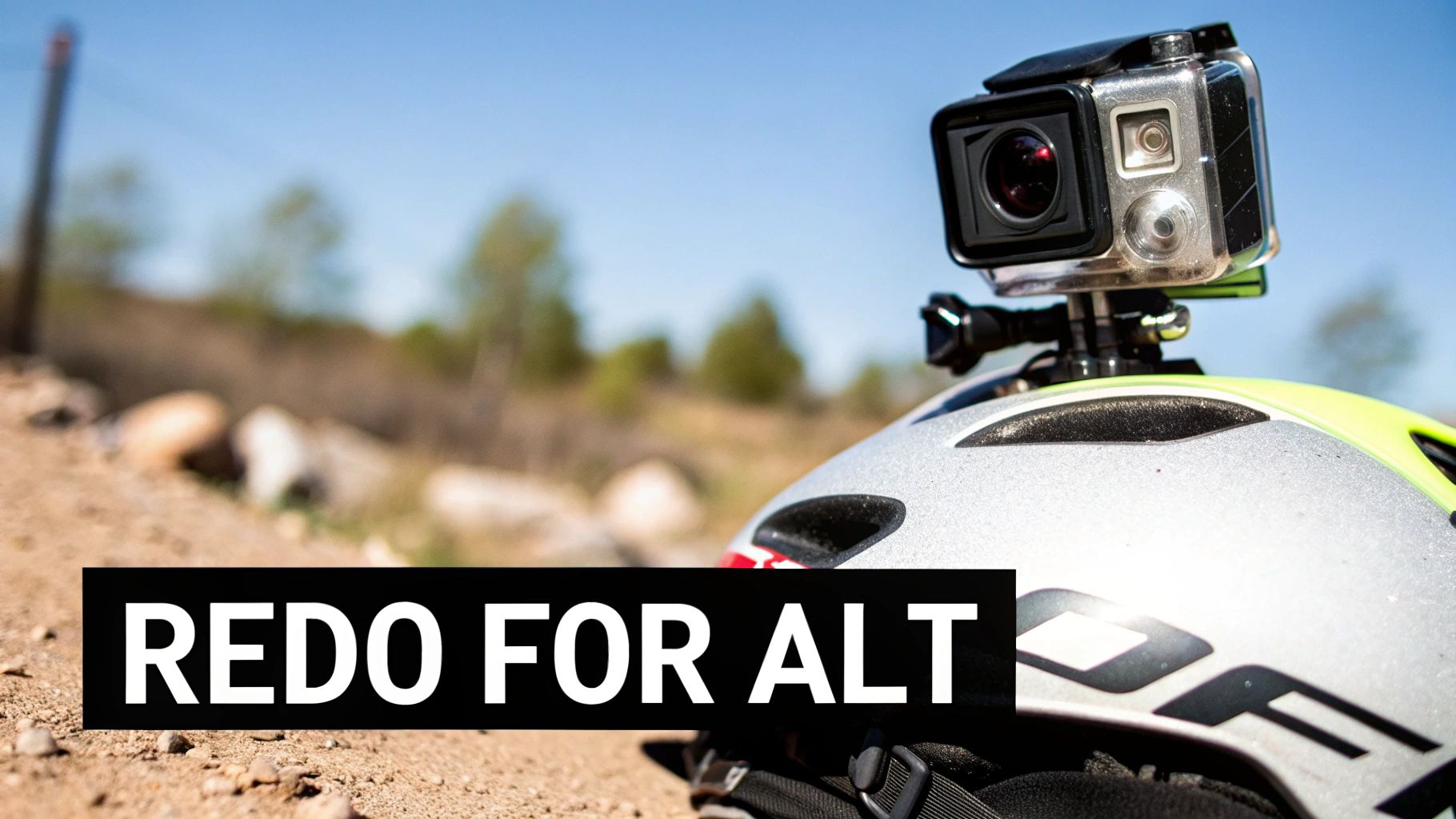
But an action camera is so much more than just a small camera. It represents a completely different philosophy on how we capture our memories. While you have to be careful with your smartphone or DSLR, the action camera is built to be part of the adventure, not just a passive observer.
Its compact size and low weight mean you can mount it almost anywhere. On your helmet as you zoom down a ski slope, on the handlebars during a forest ride, on your surfboard, or even on your dog. This versatility opens up a whole world of creative possibilities that previously required expensive and bulky equipment.
Built to withstand the elements
At the core of every action camera is its robust design. Most modern models are waterproof right out of the box, often down to 10 meters without any extra protective housing. This makes them the obvious choice for anything involving water, whether it's snorkeling in a turquoise sea or a muddy mountain bike ride in the pouring rain.
Beyond being waterproof, they are engineered to take a beating. If you drop your phone on the asphalt, it's often game over. If you drop an action camera, chances are you just happened to capture an unexpectedly dramatic camera angle. This durability gives you the freedom to focus on the experience, not on protecting your gear.
Capture life from a whole new perspective
What truly makes an action camera special is the ability to capture everything from a first-person perspective (Point of View, POV). When you attach the camera to your body or equipment, the person watching the film becomes part of the experience. They see what you see, feel the speed, and experience the excitement in a much more direct and personal way.
An action camera is less about documenting a moment and more about reliving a feeling. It shifts the focus from just seeing something happen to actually being there.
This unique perspective has made action cameras indispensable for so much more than just extreme sports:
- Sports and adventure: Film skiing, cycling, climbing, or surfing with an incredible sense of presence.
- Travel and family life: Capture the kids playing in the pool or a hike from a fun and engaging perspective.
- Creative content: Create dynamic and eye-catching videos for social media, vlogs, or even professional productions.
A modern action camera is a true powerhouse today, combining advanced technology like 4K resolution and incredible image stabilization with a simple and user-friendly design. To see how far the technology has come, feel free to read our guide to the DJI Osmo Action 6, the action camera's new masterpiece, and discover what is possible today.
Whether you're an adrenaline junkie or just want to create more vivid memories of everyday life, an action camera gives you the tools to tell your story in a way no other camera can.
Compare the features that actually matter
Choosing the right action camera can feel like navigating a jungle of technical terms. Resolution, frame rate, stabilization – what actually makes a difference when you're standing on a mountain peak or by the poolside? Let's break down the most important features so you can make a decision that fits your specific adventures.
The first thing many people fixate on is the resolution. Think of it as the level of detail in your film. A higher resolution, such as 4K or even 5K, provides a razor-sharp and more true-to-life image. It also gives you the freedom to crop and zoom into the video afterward without losing quality, which is worth its weight in gold when you want to create more dynamic clips.
But the highest resolution isn't always best. While most new cameras boast 4K, it requires a lot of storage space and a powerful computer for editing. A recording in 1080p can still look fantastic, especially on a mobile screen, and it won't eat up your memory card as quickly.
Frame rate for silky smooth slow motion
The next important spec is frame rate, measured in frames per second (fps). Standard film is 24–30 fps, which gives a natural and cinematic look. But the magic of an action camera often lies in its ability to film at significantly higher frame rates.
Why is this a big deal? Well, a higher frame rate like 60 fps or 120 fps allows you to slow down your clips and create incredibly smooth and dramatic slow motion. Imagine a perfect powder run or a leap from a cliff, rendered in detailed and silky slow motion. That's exactly what a high frame rate handles.
- 30 fps: Perfect for standard recordings like vlogs or documentary clips.
- 60 fps: Provides a smoother and more fluid video, ideal for fast sports. Can be slowed down to half speed for cool slow motion.
- 120+ fps: Created for extreme slow motion, where you can truly freeze the moment and analyze every movement.
Stabilization that works like magic on shakes
Perhaps the single most important feature in a modern action camera is image stabilization. Without good stabilization, a film from a shaky bike ride or a run becomes almost impossible to watch. Today's electronic image stabilization (EIS) has become so good that it can transform your shaky amateur clips into something that looks professional.
Think of advanced stabilization as a built-in gimbal. It anticipates your movements and compensates for them in real-time, resulting in a video so steady it almost looks like it's floating.
GoPro's HyperSmooth technology is a prime example of how effective modern stabilization can be. This is the kind of feature that truly separates a premium model from a budget alternative. If you plan to film anything more fast-paced than a calm walk, great stabilization is an absolute must.
Comparison of key technical features
To make the choice easier, we've put together a table comparing the technical specifications you can expect in different price ranges. This gives a quick overview of what you get for your money.
| Feature | Budget Model | Mid-Range Model | Premium Model |
|---|---|---|---|
| Max Resolution | 1080p / 2.7K | 4K | 5.3K or higher |
| Max Frame Rate | 30/60 fps | 60/120 fps | 120/240 fps |
| Image Stabilization | Basic EIS | Advanced EIS | Class-leading (e.g., HyperSmooth) |
| Waterproofing | Often requires housing | 5-10 meters without housing | 10+ meters without housing |
| Connectivity | Wi-Fi | Wi-Fi + Bluetooth | Wi-Fi, Bluetooth, GPS |
As you can see, you get significantly more advanced technology as you go up in price. For simpler use, a budget model might suffice, but for action-packed adventures, a mid-range or premium model is usually a better investment.
Practical features you shouldn't forget
Beyond the big three—resolution, frame rate, and stabilization—there are some practical details that have a major impact on how easy the camera is to use.
Battery life is absolutely crucial. Manufacturers often state a theoretical maximum time, but in reality, it is affected by cold, Wi-Fi, and which settings you are filming with. Expect around 60-90 minutes during 4K recording and always pack extra batteries.
Waterproofing is another key feature. Most cameras today are waterproof down to about 10 meters without an extra housing, which is perfect for snorkeling and hanging out by the pool. For deep-sea diving, however, you will need a separate underwater housing.
Finally, Wi-Fi and Bluetooth connectivity are indispensable for quickly transferring files to your phone, remotely controlling the camera, and sharing your adventures instantly.
The market for action cameras in Sweden is large, with GoPro and Insta360 being the major players for active users. By understanding these key features, it becomes much easier to find the right model for you.
To see how all of this works in practice in one of the absolute latest models, check out our in-depth guide to the GoPro HERO 12. Once you understand what the specs actually mean, finding the perfect camera for you becomes a breeze.
Find the best action camera for you
Choosing the right action camera isn't about finding the one with the most features, but about finding the one that fits you and your life. The perfect camera for an extreme athlete is rarely the best for someone who wants to film the family vacation. By understanding your own needs, you can make a choice that feels right from the very start.
To make it easier, we've broken it down into three common profiles. Do you recognize yourself in any of them?
For the adventurer pushing boundaries
Are you the one who always takes the muddiest path, climbs highest, or dives deepest? Then you are an adventurer. Your equipment must be as tough as you are, and your action camera is no exception. For you, it's not just a gadget – it's a tool that must survive and deliver when it really matters.
Here is what is crucial for you:
- Maximum ruggedness: Look for a camera built like a tank and waterproof right out of the box. A model that handles at least 10 meters depth without an extra housing is a must.
- Long battery life: When you're far from the nearest power outlet, every minute of battery life is worth its weight in gold. Prioritize cameras known for their endurance and be sure to pack extra batteries.
- Class-leading image stabilization: Whether you're mountain biking or skiing in rough terrain, you need stabilization that can work magic on the worst shakes and create smooth, fluid clips.
For the adventurer, reliability is everything. You need a camera that just works, every time.
For the vlogger and content creator
If your goal is to share your experiences with an audience on YouTube, Instagram, or TikTok, then you are a content creator. Then you need a camera that not only captures great footage but also makes it easy to create engaging content with really good audio.
Your requirements look a bit different:
- Excellent audio quality: Built-in microphones have improved, but the ability to connect an external microphone is often crucial for capturing clear and crisp audio without distracting wind noise.
- Front-facing screen: A screen you can see from the front makes it infinitely easier to compose your shots and ensure you're in focus when talking to the camera.
- Flexible shooting modes: Features like TimeWarp or Hyperlapse for dynamic sequences, as well as good low-light performance, give you more creative tools to play with.
For you, the camera is part of your storytelling process. It must be versatile and deliver results that stand out in the feed.
For the family photographer creating memories
Are you the one documenting the kids' first swim, the family reunion, or the annual camping trip? Then you are the family photographer. You don't want to mess with complicated settings; you want a simple and reliable camera that captures moments without getting in the way.
Here is what you should focus on:
- Simplicity and speed: You need a camera that's ready to film in an instant. Intuitive menus, a clear touchscreen, and perhaps even voice control make the whole experience smoother.
- Durable and waterproof: With kids involved, spills and accidents are inevitable. A robust and waterproof design means you can relax by the pool or at the beach.
- Good wide angle: An action camera’s wide field of view is perfect for fitting the whole family in the frame or capturing that grand view during a hike.
Your goal is to preserve precious memories. A simple and durable action camera is often a much smarter choice than a fragile smartphone.
The action camera challenges traditional cameras
An exciting trend is that more and more people are choosing an action camera even for tasks that traditionally belonged to DSLRs or mirrorless systems. This is clearly visible in the market, where camera sales in Sweden dropped by nearly 30 percent in a single year. Meanwhile, specialized video solutions, like a modern action camera, are taking an increasingly larger share of the pie. More and more people simply want to produce high-quality video without lugging around heavy equipment. You can read more about this market shift on Fotosidan.se.
The infographic below summarizes the three most important technical pillars – resolution, filming features, and stabilization – which are crucial regardless of what type of user you are.
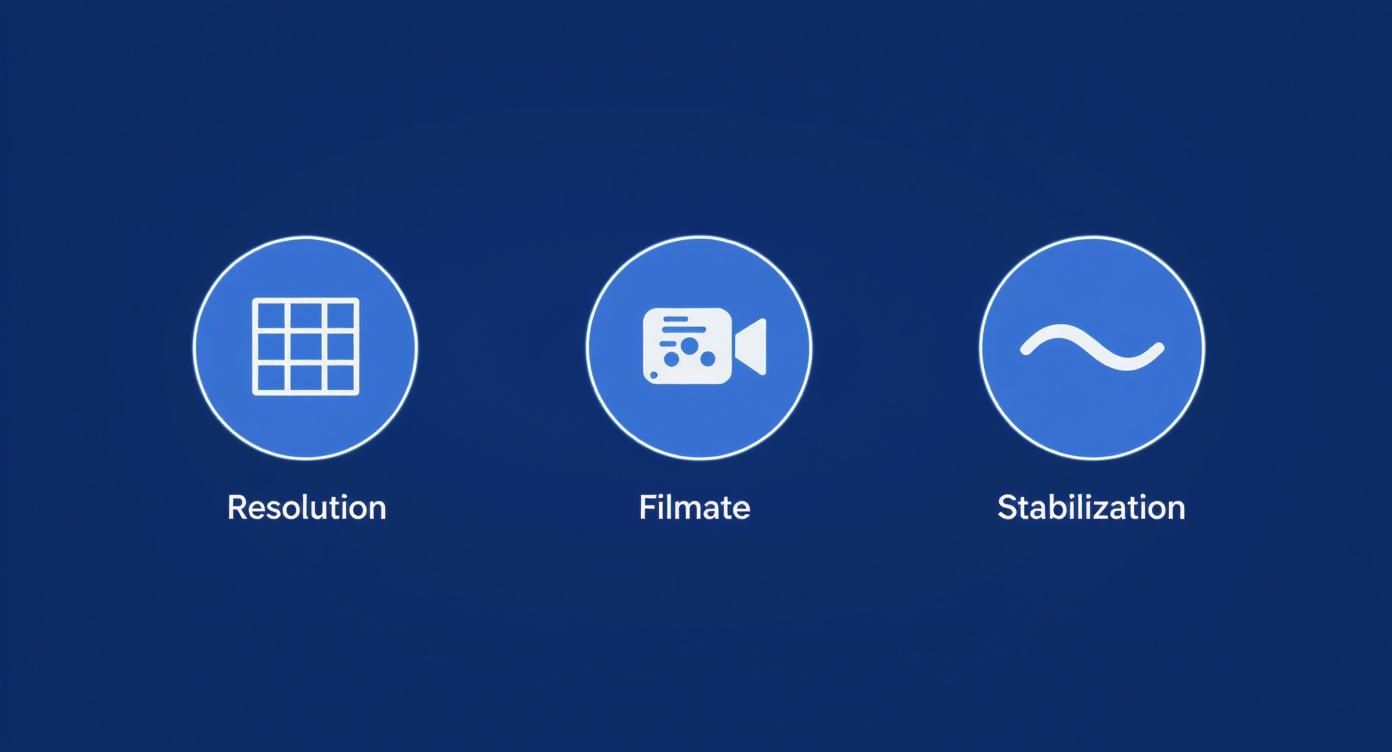
This visual summary shows how these three parts must work together to create a truly great filming experience.
Finding the right camera is about matching features with experiences. Don't ask yourself what the camera can do, but what you want to do with the camera. The answer to that question will lead you to the perfect choice.
By considering what you specifically will use the camera for – whether it's adventure, creation, or family life – you can focus on the features that will truly make a difference for you. Then you're investing in a tool that you will love and use for many years to come.
Get the most out of your action camera in practice
Sure, specs are one thing, but it's when you start filming that an action camera truly shows its worth. The whole point of these little powerhouses is their versatility – how they can transform an ordinary event into a story people actually want to watch. So, let’s leave the technology aside for a moment and look at how you can use the camera to create something really cool.
Imagine a bike ride in the forest. With an action camera mounted on the handlebars or your chest, you capture not just the nice view, but also the speed and the feeling. The viewer is pulled into every curve and gets to experience the adventure from your perspective. It's that type of first-person view that is incredibly engaging and creates a sense of presence that a regular camera rarely achieves.
But it's not just about extreme sports. An action camera is an excellent tool for creating creative and vivid films in all kinds of contexts.
From the starry sky to the kitchen counter
One of the most underrated superpowers of modern action cameras is the ability to create awesome timelapse videos. Put the camera on a tripod on a clear night, set it to take a photo every 30 seconds, and let it go to work. The result? A magical film where the stars dance across the sky – an effect that previously required very expensive and advanced equipment.
Even indoors, the camera works wonders. Attach it with a suction cup above the stove and film your cooking from a unique bird's-eye view. The wide lens captures the entire workspace, providing a professional and dynamic feel that is perfect for social media.
An action camera is about finding new angles on things you already know. It's a tool that triggers creativity, whether you're filming a mountain or a tray of cinnamon buns.
A favorite tool for influencers and creators
It's no coincidence that creators on TikTok and YouTube love these small cameras. They are perfectly suited for creating engaging user-generated content (UGC), which is one of the pillars of today's marketing. In fact, influencers on platforms like TikTok and YouTube account for over 90 percent of all video views, and action camera clips are a common sight. They have become so important that major brands often use UGC filmed with action cameras in their own advertising campaigns.
Their popularity stems from a few simple things:
- Authenticity: The raw and direct perspective feels honest and credible.
- Dynamics: Image stabilization allows you to film in full motion and still get a smooth, fluid result.
- Simplicity: It's lightning-fast to capture a moment and transfer it to your phone for instant publishing.
Create deliberate effects with the right settings
To truly elevate your films, you need to think about how mounts and settings work together. Understanding that connection is the key to creating well-thought-out and great-looking videos.
One thing often forgotten is audio, especially if you talk in your clips. An action camera's built-in microphones are okay, but to capture crystal-clear sound without distracting wind noise, an external solution is almost a must. For vloggers and others who want professional audio, we highly recommend investing in a wireless lavalier microphone or another external mic. Read more about the benefits in our guide to wireless microphones.
Once you've filmed your adventures, the next step is to transform the raw material into a finished film. For this, you need some basic knowledge of how to assemble your clips. By learning simple video editing, you can cut, add music, and adjust colors to give your films that final professional touch. These are the steps that turn a collection of good clips into a fantastic film that people actually want to watch.
Choose accessories that elevate your films
An action camera is a great tool right out of the box, but you unlock its true potential with the right accessories. Think of the camera as the brain of your operation. The accessories are the specialized equipment that allow you to perform any conceivable mission. Without them, it's a bit like having a Formula 1 car but only driving it in a parking lot – you kind of miss the whole point.
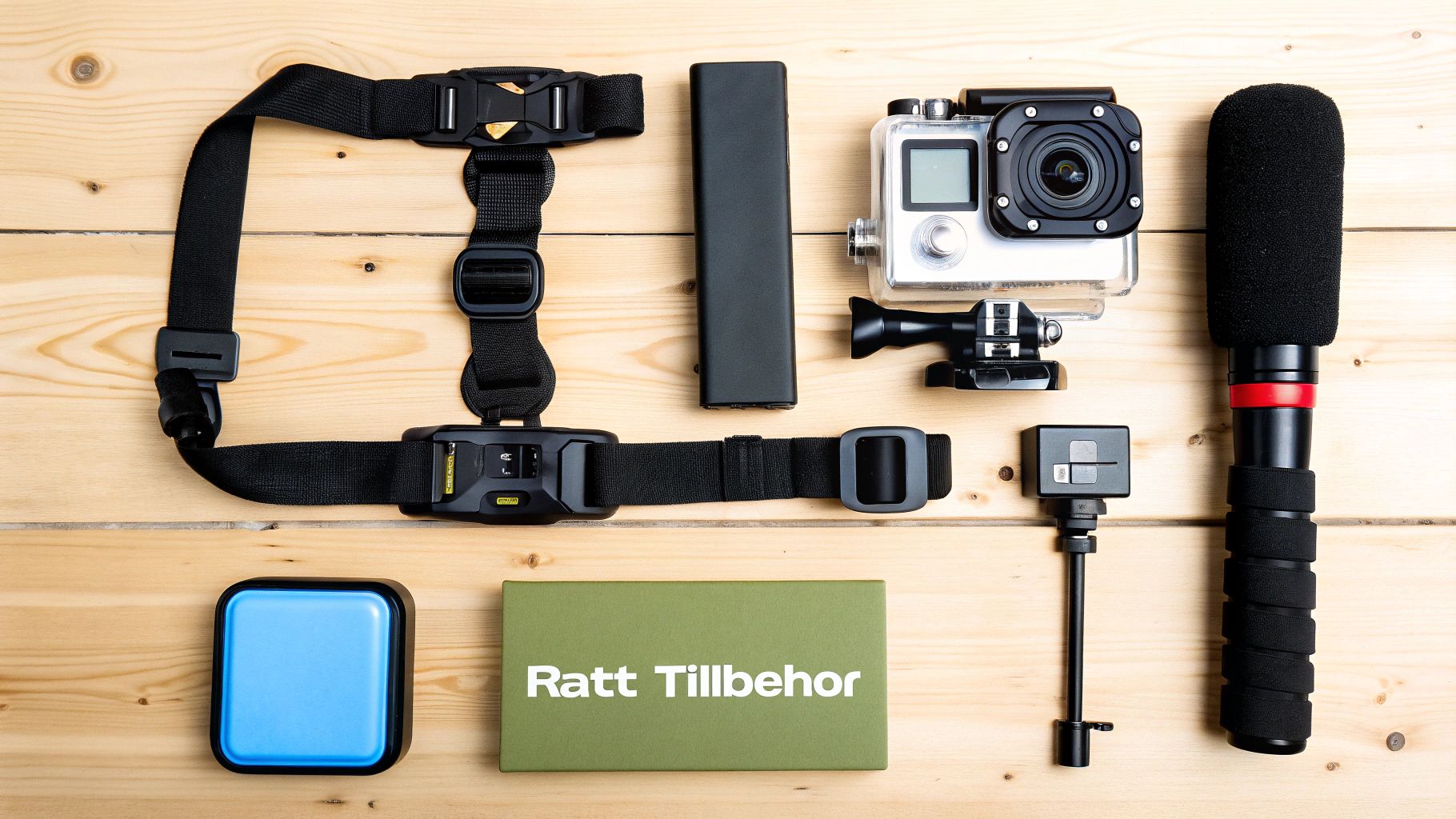
Choosing accessories isn't about buying everything you see. It's about building a smart and personal kit that matches your specific ambitions. Let's break down the most important categories so you can make smart choices that actually take your films to the next level.
Mounts for unique angles
The first and perhaps most important category is mounts. These are what allow you to place your action camera in creative spots to capture those unique first-person perspectives. Without mounts, you're stuck holding the camera in your hand, which is incredibly limiting.
The most basic and useful mounts are:
- Chest Harness: Perfect for skiing, cycling, or hiking. It provides a stable and immersive view where the viewer sees your arms and equipment, creating a strong sense of presence.
- Helmet Mount: A true classic for everything from motorsports to climbing. Provides a higher view that shows exactly what you see.
- Suction Cup: Incredibly versatile for attaching the camera to smooth surfaces like cars, boats, or windows. Provides cool, moving shots with a professional look.
- Clamp Mount: Can be attached to almost anything – a branch, a fence, or a backpack strap. Great for quickly finding a creative angle.
To make it easier, we've put together a small table of the most essential accessories for those just starting out.
Top 5 most important accessories for beginners
| Accessory | Area of Use | Why it’s important |
|---|---|---|
| Chest Harness | Skiing, MTB, Hiking | Provides an immersive "point of view" feel that is hard to beat. |
| Extra Batteries | All activities | Prevents you from missing the best moment due to a dead battery. |
| Memory Card (V30) | High-res filming (4K) | A fast card is a must to avoid choppy or lost clips. |
| Handle/Selfie Stick | Vlogging, general filming | Provides a steadier grip and more creative angles than just holding the camera. |
| Small Tripod | Timelapses, static shots | Indispensable for sharp, shake-free images when the camera must stand completely still. |
This list is a great starting point for building a kit that covers most situations without having to buy a bunch of gear you'll rarely use.
Stability for professional results
While modern action cameras have incredible built-in image stabilization, there are situations where extra stability makes all the difference. It's about capturing those calm, controlled shots that contrast with an intense action sequence.
A simple handle or a "selfie stick" gives you not just better reach, but also a much steadier grip that reduces minor shakes. For static shots, like a sunset timelapse, a small and lightweight tripod is absolutely indispensable. It guarantees the camera remains perfectly still, which is essential for a professional and sharp result.
Stability accessories are all about control. They allow you to decide exactly how the image should look, instead of just letting the camera go along for a shaky ride.
Power and storage for uninterrupted filming
There's nothing worse than when the battery dies or the memory card fills up just when the most exciting thing happens. Planning for power and storage is one of the most important preparations you can make, trust me.
Extra batteries are an absolute given. A standard battery rarely provides more than 60–90 minutes of recording time in high resolution. Always carry at least one fully charged extra battery. For those who want to be extra prepared, there are dual chargers that can charge two batteries simultaneously.
Equally important is having a fast and reliable memory card. To film in 4K, a card with high write speed is required – look for the V30 rating. Skimping on the memory card can lead to lost files and choppy recordings. Make sure you have enough space for the whole adventure. If you want to know more, you can read our guide to essential GoPro accessories like batteries and filters.
Protection and audio quality
Don't forget to protect your investment and improve the audio. A protective housing isn't just for deep-sea diving. It can also provide extra protection against shocks, scratches, and dirt in tough conditions, such as muddy terrain or a sandy beach.
Audio is often an action camera's Achilles' heel, especially in windy conditions. If you plan to talk in your films or want to capture environmental sounds clearly, an external microphone is a fantastic upgrade. There are wind muffs and adapters that make the audio significantly better and give your films a much more professional feel.
By investing smartly in a few, well-chosen accessories, you can transform your action camera from a simple gadget into a complete system for capturing and telling your stories.
Frequently asked questions about action cameras
Entering the world of action cameras is exciting, but it's completely normal to have a lot of questions at first. All the technology, all the accessories, and endless settings can easily feel a bit overwhelming.
Therefore, we have gathered and answered some of the absolute most common questions that arise for both new and prospective owners. Think of it as a quick guide giving you short, direct answers so you can feel confident with both your purchase and how you use the camera afterward.
How long does the battery last on an action camera?
This is probably the most common question of all, and the short answer is: it depends. Battery life is affected by everything from the model and settings to how cold it is outside. But a good rule of thumb is that you can expect about 60–90 minutes of filming time if you are shooting in 4K.
Want to squeeze out more time? No problem. Lower the resolution to 1080p, turn off Wi-Fi and GPS, and lower the screen brightness. These small adjustments can make a big difference.
For longer adventures, like a full day of skiing on the slopes or a mountain hike, extra batteries aren't just a good idea – they're a must. Make sure to always have at least one fully charged extra battery in your bag.
Which memory card do I need?
The choice of memory card is absolutely crucial, especially if you want to film in high resolution. A card that is too slow can cause the film to stutter, files to disappear, or the camera to simply stop recording in the middle of everything.
To ensure everything flows smoothly when filming in 4K, you need a fast and reliable microSD card. Look for the V30 or UHS-I U3 rating on the packaging. These guarantee a write speed that can handle the large amounts of data that 4K video creates.
Also, always check what the camera manufacturer recommends for the maximum size of the card. Some models have an upper limit on how many gigabytes they can handle.
Can I use it as a regular photo camera?
Absolutely! Many people don't think about it, but modern action cameras are quite sharp still-image cameras too. They take high-quality photos and often have features like HDR for better colors and the ability to shoot in RAW format, giving you enormous freedom when editing your images.
The characteristic wide-angle lens also provides a unique and sweeping perspective. Perfect for grand landscapes, cool architectural shots, or group photos where you want to be sure to get everyone in. Thanks to its durable and compact design, it's an excellent travel camera that goes everywhere with you.
Is a more expensive action camera always better?
No, not necessarily for everyone. It's easy to fall into the trap that the most expensive model with the most features is automatically the best, but it's rarely that simple. A more expensive camera obviously gives you advantages like higher resolution and better image stabilization, which is awesome for those who truly push their gear.
But if you're mostly going to film the family vacation or the weekend's adventures, a stable mid-range camera can give you much more for your money.
Consider what you will actually use the camera for. Is it a must to film in 5.3K, or is a really good 4K camera more than enough? Be honest with yourself and you'll make a smarter choice that you'll be happy with in the long run.
Do you have more questions or are you ready to find the perfect accessories for your action camera? At ActionKing, you'll find the Nordic region's largest selection of everything you need to capture your adventures. Explore our range of mounts, batteries, filters, and much more at https://actionking.se.


