

The best camera for your YouTube channel is the one that manages to find the perfect balance between high video quality, accurate autofocus, and good audio capabilities – all within the limits of your budget. Which model is best for you depends entirely on what kind of content you are passionate about, whether it's fast-paced vlogs on the go or carefully planned studio productions.
How to choose the right camera for your YouTube channel
Choosing a camera is one of the first and most important decisions you make as a creator on YouTube. It's about so much more than just technical specifications; it's about finding a tool that fits your specific way of working and helps you bring your ideas to life. A good start is always to consider what kind of videos you actually want to make.
Understand your unique needs
Different types of content place completely different demands on equipment. A vlogger filming themselves walking through the city needs a lightweight camera with great image stabilization and a screen that can flip forward. A creator recording tutorials at a desk instead prioritizes razor-sharp 4K resolution and the ability to plug in an external microphone for perfect sound.
It's easy to get caught up in the hunt for the "perfect" camera, but the truth is that the best camera for YouTube is the one that best matches your goals and the type of films you want to create.
Before you commit, ask yourself a few simple questions:
- Where will you be filming? Outdoors in changing light conditions or in a controlled studio environment?
- How much will you move? Will the camera stay still on a tripod or does it need to follow you on the go?
- What is your technical level? Do you want a simple "point-and-shoot" camera or are you comfortable adjusting settings manually?
The three main types of cameras
To make the choice a bit easier, we can divide the most common cameras into three groups. Each category has its strengths and suits different types of creators.
| Camera Type | Best Suited For | Main Advantages |
|---|---|---|
| Smartphones | Beginners, social media, spontaneous clips | Extremely portable, easy to use, cost-effective |
| Compact Cameras | Vloggers, travelers, creators on the go | Lightweight, flip screen, sharp autofocus |
| System Cameras | Studio production, serious creators, cinematic content | Interchangeable lenses, best image quality, full manual control |
Your mobile phone is actually a surprisingly good starting point. Today's phones film in 4K and with the right accessories, like a stable phone tripod for filming, you can achieve a truly professional result.
When you feel you want more creative control, such as being able to create that nice, blurry background (bokeh) or film in low light, it's time to look at a compact or system camera. They have larger sensors and better lenses, which directly gives you higher image quality and more creative possibilities for your YouTube channel.
What makes a good YouTube camera? Here are the features that matter
Understanding the technology behind a great video is essential for creating content that actually stands out. A modern YouTube camera is so much more than just a gadget that records film – it's a tool with specific features built to make life easier for you as a creator. Let's dive into the characteristics that really make a difference.
To achieve that coveted cinematic feel with nice depth and a softly blurred background (bokeh), the camera's sensor size is the most important piece of the puzzle. A larger sensor, such as an APS-C or full-frame sensor, simply captures more light. This not only yields better results in low light but also gives you creative control over depth of field, helping you isolate the subject from the background in a professional way.
Autofocus you can trust
As a solo creator, you rarely have the luxury of having your own camera operator. This is exactly where a smart autofocus system becomes your very best friend. Today's cameras use advanced technology to keep you in perfect focus, even when you move.
A truly great YouTube camera must have fast and accurate autofocus. Look for features like:
- Eye Detection (Eye AF): The camera finds and locks focus on your eye, ensuring your face is always sharp. This is invaluable for vlogs or when talking directly to the camera.
- Tracking Autofocus (Tracking AF): The system can follow a specific subject moving in the frame. Perfect for product reviews where you show items off, or for more dynamic scenes.
A reliable autofocus system reduces the number of failed takes and lets you focus on your content instead of the technology. It's the difference between a smooth recording and constant frustration.
Without good autofocus, you risk important parts of your video becoming blurry, forcing you into time-consuming and frustrating retakes.
Image quality and resolution that lasts
Today, 4K resolution has become more or less standard for anyone who wants to create high-quality content. Even if many people still watch YouTube in 1080p, recording in 4K gives you massive advantages when you get to the editing stage.
With a 4K recording, you can easily crop the image, zoom in on details, or create digital pans without losing sharpness when you export the final video in 1080p. This gives you incredible flexibility and makes your production more future-proof.
Stabilization for content in motion
Shaky videos are one of the surest ways to make viewers click away. Effective image stabilization is therefore a must, especially if you plan to film a lot without a tripod.
There are two main types of stabilization to keep an eye on:
- In-body Image Stabilization (IBIS): The sensor inside the camera body physically moves to counteract your movements. This is the most effective method and works with any lens you put on the camera.
- Optical Image Stabilization (OIS): Here, the stabilization is built directly into the lens. It works well but is limited to that specific lens.
For vloggers and creators filming on the go, a camera with IBIS is an investment that pays off immediately. It gives you the freedom to create smooth, fluid clips without having to carry heavy equipment like a gimbal. If you plan to use your camera for that type of content, you can read more in our guide on stabilization with DJI Osmo.
Small details that simplify everything
Beyond the major technical specifications, there are a few minor features that can dramatically improve your recording experience. A flip-out screen is an absolute must for anyone filming themselves. It lets you see exactly what the camera is recording, making it easy to compose the shot and ensure you are in focus.
Another critical detail is sound. Even the best-looking video can be ruined by bad audio. Almost all built-in camera microphones are mediocre at best. Therefore, make sure your chosen camera for YouTube has a 3.5 mm microphone input. This allows you to connect an external microphone to capture crystal-clear sound that matches your high image quality. Sound is, without a doubt, half the experience.
Comparison of popular cameras for different budgets
Finding the right camera for YouTube is about matching features with your wallet and your creative dreams. The market is full of great options, but the "best" camera doesn't really exist – only the best camera for you. That's why we've divided our favorites into three clear segments to make the choice a bit easier.
Here we look at specific models and how they actually perform in real situations for a YouTube creator. We skip long, technical spec lists and focus instead on what matters: how well the autofocus keeps up when you move, and how good the image looks straight out of the camera.
Budget alternatives that deliver
Starting a YouTube channel doesn't have to cost a fortune. Today, there are fantastic and budget-friendly cameras offering features that just a few years ago were reserved for significantly more expensive models. These cameras are perfect for beginners looking to step up from a mobile phone without emptying their savings account.
A real bestseller in this class is the Sony ZV-1 II. It is built from the ground up for vloggers and content creators. Its greatest strength is its ease of use – it has smart modes like "Product Showcase" that instantly switches focus from your face to a product you hold up, and a "Bokeh Switch" to instantly get that nice, blurry background.
The autofocus is fast and reliable, especially for a camera in this price range. The built-in microphone is also surprisingly capable, making it a complete starter pack. The downside is the fixed lens, which of course limits flexibility compared to a system camera.
Another strong contender is the Canon EOS M50 Mark II. This is a compact system camera that gives you the freedom to change lenses, opening up a whole new world of creative potential. It is equipped with Canon's acclaimed Dual Pixel autofocus and a fully articulating touchscreen, perfect when filming yourself. It offers incredible value for money and is a great entry into more advanced filming.
Mid-range – where quality meets value
When you feel ready to level up your production, the mid-range is the obvious step. Here you find cameras that give you access to advanced features like uncropped 4K video, superior low-light performance, and more robust camera bodies.
The Sony A6700 is a true workhorse in this segment. It has inherited its AI-driven autofocus system from Sony's significantly more expensive full-frame cameras, providing almost uncanny accuracy and tracking. It can also film in 4K at up to 120 frames per second, which is fantastic for creating dramatic slow-motion sequences.
This camera is a perfect choice for creators making varied content, from studio talk to more action-packed scenes. It's compact enough for vlogging but powerful enough for serious productions.
A tough competitor is the Fujifilm X-S20. Fujifilm is known for its magical color reproduction straight out of the camera, which can save tons of time in editing. The X-S20 also features in-body image stabilization (IBIS), a massive advantage when filming handheld. It also has a dedicated "Vlog Mode" that simplifies settings for new users.
For many creators, the mid-range is the perfect place to be. Here you get access to professional features without having to pay premium prices. An investment in this class can last for many years to come.
To summarize what to look for, it can be boiled down to three core areas: the sensor that captures the light, the autofocus that keeps you sharp, and the audio input that secures quality.
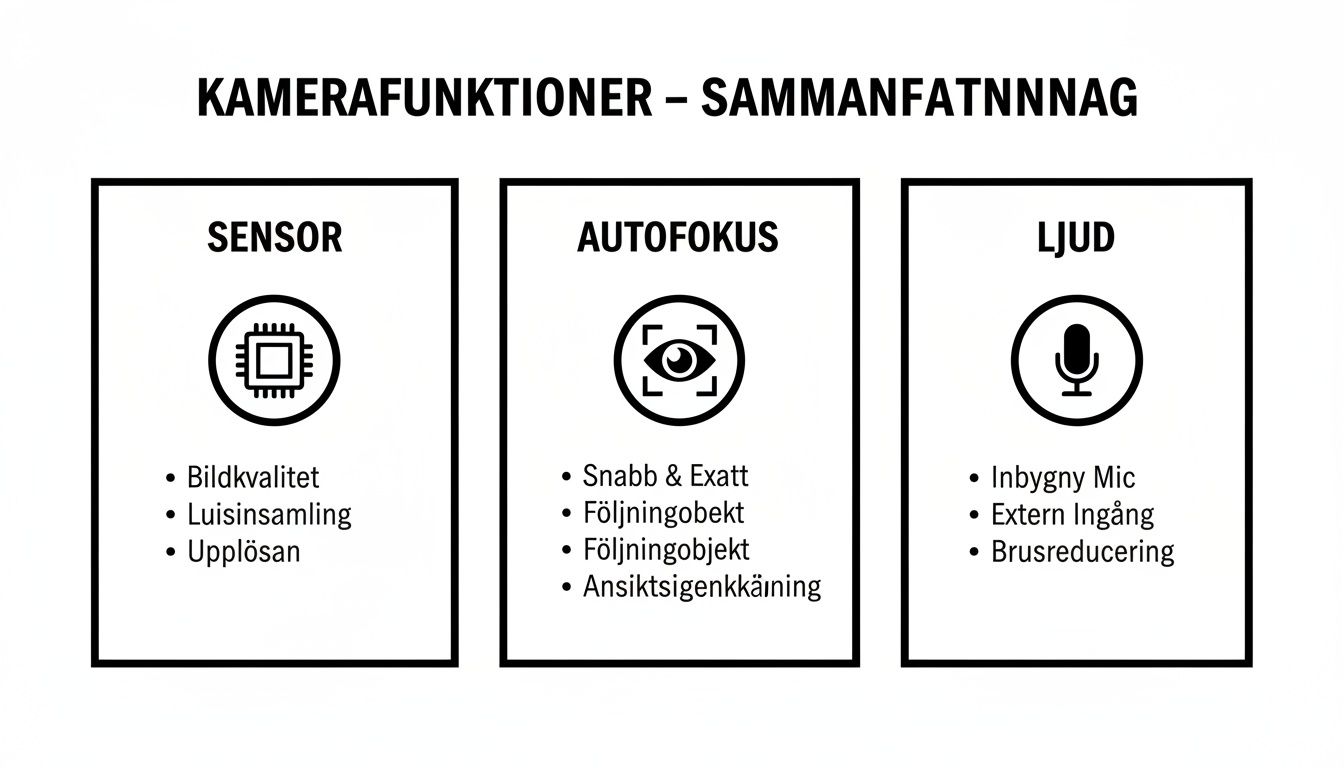
The graphic above shows the three pillars of a truly great YouTube camera: a capable sensor, a smart autofocus system, and flexible audio options.
Premium cameras for uncompromising quality
For the creator who refuses to compromise on quality and sees their YouTube channel as a business, the premium segment offers the absolute best technology available today. We're talking full-frame sensors, professional video formats, and image quality suitable for broadcast television.
The Sony A7 IV is one of the most popular hybrid cameras on the market, and for good reason. It combines a high-resolution 33-megapixel sensor with Sony's world-leading autofocus technology and phenomenal video features. It films in 10-bit 4:2:2, giving you enormous flexibility when color grading in post-production.
This camera is tailor-made for creators aiming for a cinematic look. It's a favorite among everyone from wedding videographers to studio producers and YouTubers who demand the very best.
Another heavyweight in the top tier is the Canon EOS R6 Mark II. This camera is famous for its incredible low-light performance and class-leading image stabilization, which makes handheld filming extremely smooth and fluid. The autofocus is also phenomenal and can identify and track not only people but also animals and vehicles with impressive precision. It is a superb choice for dynamic content where conditions are constantly changing.
The Swedish YouTube scene is incredibly professional and competition is stiff. With over 100 Swedish channels having more than a million subscribers, demands on production quality are higher than ever. Popular genres like comedy and music videos, dominated by creators like JLC and KAJ, show that investing in high-quality equipment is necessary to stand out. In fact, over 70% of watch time on major Swedish channels comes from abroad, demonstrating global reach. Read more about trends on Swedish YouTube at Feber.
For those creating high-action and adventure content, there are also specialized options. If you want to know more about the best models for fast-paced scenes, read our guide on best action cameras in test.
Comparison of Recommended YouTube Cameras
To provide a quick overview, we've gathered key specifications and prices for our selected favorites. Use the table to easily compare and find a camera that fits your specific needs.
| Camera Model | Camera Type | Max Resolution | Autofocus System | Price Range | Best Suited For |
|---|---|---|---|---|---|
| Sony ZV-1 II | Compact | 4K/30p | Fast Hybrid AF | Budget | Vloggers, beginners |
| Canon EOS M50 II | Mirrorless | 4K/24p | Dual Pixel CMOS AF | Budget | Creative control on a budget |
| Sony A6700 | Mirrorless | 4K/120p | AI-based AF | Mid-range | The all-round creator |
| Fujifilm X-S20 | Mirrorless | 6.2K/30p | Intelligent Hybrid AF | Mid-range | Handheld filming, color |
| Sony A7 IV | Mirrorless | 4K/60p | Real-time Tracking AF | Premium | Professional production |
| Canon EOS R6 II | Mirrorless | 4K/60p | Dual Pixel II AF | Premium | Low light, dynamic |
Choosing the right camera for YouTube is a personal journey. Use this comparison as a starting point to find the model that best matches your vision, workflow, and budget.
Tailor the camera to your specific content
The "best" camera on paper is rarely the best for your specific YouTube channel. Different types of content place completely different demands on equipment, and the key is finding a tool that fits your unique way of creating. It's less about technical specs and more about how the features work in practice – for you.
A vlogger running around the city has completely different needs than someone calmly unboxing products in a studio. So let's break it down and look at what works best for some common YouTube genres.
Camera for the vlogger on the go
If you create vlogs, portability and simplicity are key. The camera must be an extension of your arm, a reliable companion that captures the moment without getting in the way. The hunt for the perfect vlogging camera is really about three things.
Here is what you should look for:
- Good In-body Image Stabilization (IBIS): This is invaluable. Good stabilization smooths out shakes when you walk and talk, providing a smooth and professional result without you needing to carry a gimbal.
- Low weight and compact format: A heavy camera quickly becomes an annoyance during a long day. A light and small model is easier to handle, fits anywhere, and allows you to film longer.
- A flip screen: Being able to see yourself while filming is a must for a vlogger. It ensures you are in the frame and that the focus is where it should be.
For a vlogger, the camera should feel immediate – fast, reliable, and ready to capture the moment. Here, smart features almost always win over raw image quality.
Cameras like the Sony ZV-E10 or DJI Pocket 2 are perfect examples. They are built from the ground up for exactly this, with a superb balance between performance and portability. If you want to know more about one of the most popular vlogging cameras right now, you can read our detailed guide on DJI Pocket 2.
Camera for the studio and tutorials
If your channel is instead about content from a fixed location – like makeup tutorials, product reviews, or educational videos – the rules change completely. Now, mobility is no longer what matters, but maximum image quality and reliability during long recording sessions.
Your focus should be on features that really raise the visual bar:
- Superior image sharpness: A larger sensor (APS-C or full-frame) combined with good lenses is essential for that razor-sharp image that makes every detail visible.
- Natural color reproduction: Look for a camera known for its beautiful and accurate colors straight out of the box. This saves tons of time in editing.
- Option for continuous power: Being able to plug the camera directly into a wall outlet (using a "dummy battery") is a lifesaver. This way, you don't have to worry about the battery dying in the middle of an important take.
Models like the Sony A6700 or Canon EOS R8 are fantastic in a studio environment. They deliver incredible 4K video and give you the control you need to create professional and polished content.
Camera for adventure and travel
For those creating content about adventure and travel, durability and versatility are most important. The equipment must withstand tough conditions – from dusty roads to sudden rain showers – while also being able to capture both grand landscapes and fast action.
A robust system camera with weather sealing is a smart investment. It protects the sensitive electronics from moisture and dirt, allowing you to keep filming regardless of the weather. Features like high frame rates (e.g., 120 fps in 4K) are also worth their weight in gold for creating dramatic slow motion of everything from waves crashing against rocks to a bird gliding through the air.
The Swedish audience is dedicated, to say the least. New statistics show that YouTube reaches a staggering 89.3% of all internet users in Sweden, placing us in a strong fourth place globally. This means nearly nine out of ten Swedes with internet access use the platform regularly – a figure that shows the enormous potential for local creators. Read more about Sweden's strong position in YouTube's global landscape.
By considering what your specific niche requires, you can make a much better choice. You aren't just choosing a "camera for YouTube," you're choosing the right tool to tell your story in the best possible way.
The equipment that elevates your video production
A great camera is a fantastic start, but it's the accessories that really take your videos from "good" to "wow." The right peripheral equipment is often what separates an amateurish production from a professional one, and the best part? You don't have to empty your wallet to get a significant boost in quality.
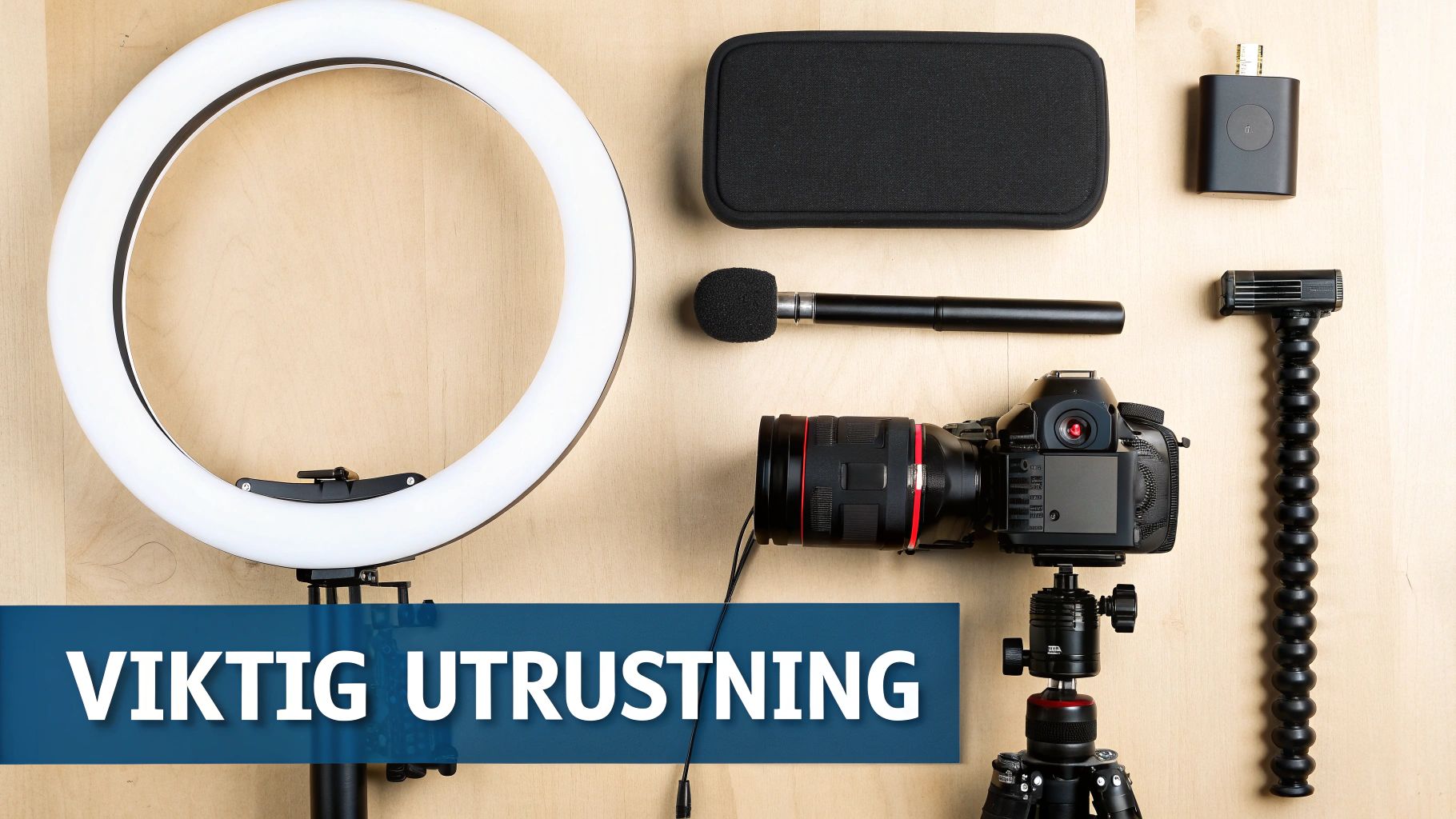
The absolute most important investment you can make after the camera is sound. Viewers can forgive an image that isn't razor-sharp, but poor audio makes most people click away immediately. The camera's built-in microphone is rarely enough – it picks up sound from all directions, including echoes, fans, and everything else you don't want included.
Choose the right microphone for your purpose
To capture clear and crisp sound, there are three main types of microphones to consider. Each type has its own strengths and suits different filming scenarios.
- Shotgun Microphone: This type is usually attached directly to the camera. It is designed to capture sound directly in front of it while filtering out distracting noise from the sides. Perfect for vlogs on the go or interviews where you want to isolate a voice from a busy background.
- Lavalier Microphone (Lapel mic): A small, discreet microphone that you clip onto clothing, close to the mouth. It is unbeatable for getting consistent and clear sound in a studio, in tutorials, or when you move a lot. The sound level remains the same regardless of where you turn your head.
- USB Microphone: Connects directly to the computer and is the obvious choice for voiceovers, streaming, or podcast recording. It often provides studio quality at a great price but is obviously not as convenient for recordings away from the desk.
Spending as little as 500–1000 SEK on an external microphone can make a bigger difference to your YouTube channel than a camera upgrade costing tens of thousands.
Lighting that creates depth and mood
After sound, lighting is the fastest way to increase production value. Good lighting isn't just about being clearly visible – it creates depth in the image and gives a more polished and professional impression.
A simple ring light is a popular and affordable start for many creators. It provides a soft and flattering light that removes harsh shadows on the face, which is ideal when talking directly to the camera.
If you want more control and a more cinematic feel, a softbox kit is the next step. A classic three-point lighting setup – with a key light, a fill light, and a backlight – is the standard in professional film. This setup helps separate you from the background and gives the image a nice, three-dimensional depth.
Stability is key to professional shots
Shaky videos look sloppy and can be incredibly distracting for the viewer. A stable foundation for your camera is therefore essential for achieving those clean, nice shots.
| Stabilization Tool | Best For | Main Advantage |
|---|---|---|
| Tripod | Stationary recordings, interviews, tutorials | Provides a completely still and stable image. Indispensable in a studio environment. |
| Gimbal | Moving shots, vlogs, action scenes | Uses motors to actively counteract shakes and create smooth, cinematic movements. |
A simple tripod doesn't have to cost much but makes an enormous difference. For those who film a lot in motion, a gimbal is a fantastic investment that gives your videos a dynamic and professional feel that was once difficult to achieve without very expensive equipment.
With so many Swedes watching YouTube, expectations for quality are high. The report The Swedes and the Internet shows that a full 80% of Swedes use the platform, and nearly a third watch daily. To capture and keep the audience's attention in such a mature market, a good idea isn't enough – you need the right tools. Choosing the right accessories is what lets your camera for YouTube truly shine.
Frequently Asked Questions about YouTube Cameras
Have you read this far? Then hopefully you have a much clearer picture of which YouTube camera might suit you. At the same time, a few final thoughts almost always crop up right before you're about to pull the trigger and invest.
That's why we've gathered the most common questions here. See it as a final checklist so you can feel completely confident in your choice.
Can I really start with just my phone?
Absolutely! The answer is a resounding yes. Modern smartphones have surprisingly good cameras that can easily handle video in 4K resolution. For a beginner, the mobile phone is the smartest and cheapest way to get started.
The weak points are almost always sound and stability, but these are easily fixed. An external microphone and a small tripod transform your phone into a fully capable recording rig. By starting with your phone, you get the chance to learn the basics of image, light, and storytelling before spending money on more expensive gear.
How important is the lens, really?
The lens is at least as important as the camera body itself, if not more so. Think of the camera as the brain and the lens as the eye. It is the glass in the lens that determines how light is captured and thus affects everything from sharpness and colors to how nicely blurred the background becomes.
A good lens is often a smarter investment than the most expensive camera body. Quality glass makes a huge difference to your image quality and can stay with you for many years, even if you upgrade your camera in the future.
A system camera gives you the freedom to change lenses depending on what you're filming:
- Wide-angle lens: Perfect when vlogging and you want to include a lot of your surroundings, or when filming in a cramped room.
- Standard lens (approx. 35-50 mm): An incredibly versatile choice that provides a natural perspective, similar to what our eyes see.
- Telephoto lens: Used to zoom in on things far away or to compress the background and create that cinematic depth.
Do I need to film in 4K?
Most people still watch YouTube in 1080p, but filming in 4K gives you massive advantages. When you record in a higher resolution, you capture so much more detail, which gives you incredible flexibility during editing.
For example, you can zoom into the image, change the framing, or create digital pans without it becoming pixelated when you then export the video in 1080p. Filming in 4K is also a way to future-proof your material. Your videos will look crisp and professional even as 4K screens become the standard for everyone.
What is the difference between a compact camera and a mirrorless system camera?
The single biggest difference is that you can change lenses on a system camera, while a compact camera has a fixed lens. This gives the system camera a completely different level of flexibility and potential to grow with you.
Compact Camera:
- All-in-one solution, easy to get started with.
- Small and light, perfect for travel and "on the go" vlogs.
- You are locked into the lens the camera was built with.
System Camera:
- You can customize the camera with different lenses for different purposes.
- Often significantly better image quality thanks to larger sensors.
- Gives you complete creative control over the result.
The choice simply comes down to your ambitions. If you want a convenient "point and shoot" solution, a compact camera is great. But if you see your YouTube channel as a long-term project where you want to be able to grow creatively, then a mirrorless system camera is the best investment you can make.
At ActionKing, you'll find the Nordic region's largest selection of accessories to help you take your video production to the next level, regardless of which camera you choose. Explore our range of tripods, microphones, and lighting at https://actionking.se.


